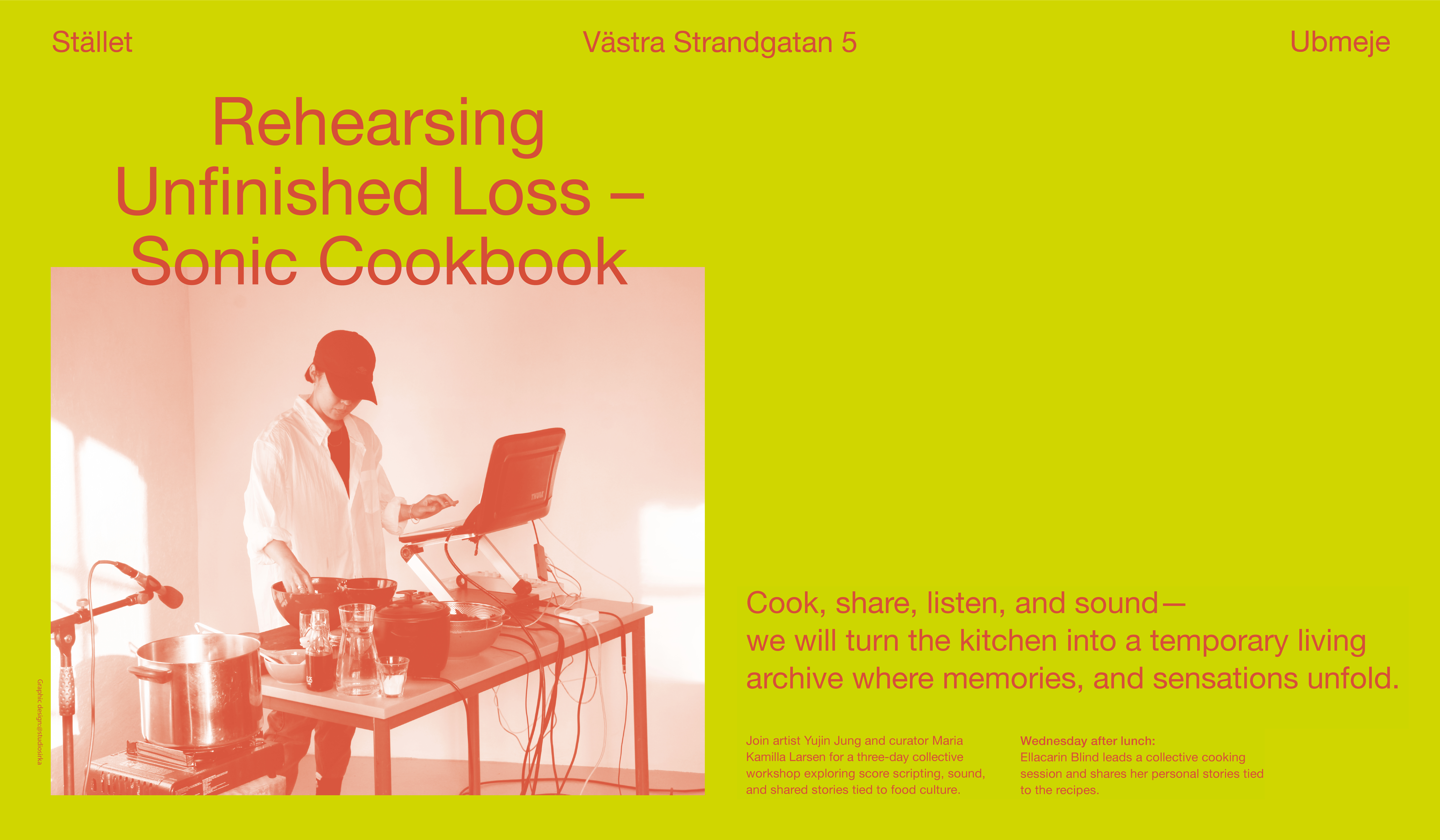
Workshop: Rehearsing Unfinished Loss – Sonic Cookbook
Where: Stället, Västra Strandgatan 5B, Umeå
When: 22–24 April
Wed: 10:00–16:00 | Thu: 12:30–16:00 | Fri: 12:30–16:00
Nevertheless, loss
keeps resounding,
unarchived, unvoiced,
and still ungrieved.
Only the hemp stands upright, coldly green across the fields.
(Excerpt from a score-script in progress)
Some forms of loss do not end; they remain incomplete, carried through gestures and rhythms, and become entangled in the material world as unspoken ripples rather than archived or written accounts. Understood as a lived, sensory condition, unfinished loss moves through the subterranean registers of memory, affect, and habitual relations.
How does lingering loss haunt everyday—between living landscapes and the table?
Through traditions unevenly passed down, ingredients tied to disappearing landscapes, and practices shaped by migration, movement, and shifting bodies.
Multidisciplinary artist Yujin Jung and curator Maria Kamilla Larsen invite you to a three-day collective workshop that situates these questions within a Västerbotten kitchen. Together, we’ll gather, cook, tell stories, listen, and share—turning the kitchen into a temporary living archive where memories, smells, and tastes unfold through and around recipes.
Over the three days, we'll cook, write, listen, and experiment with sound—testing whether recipes can operate as scores, through which unfinished loss may be sensed, rehearsed, and shared.
Outline of the three-day workshop
Day 1 (open to everyone):
Part I: Listening and sounding body
Beginning with an instruction from Yujin Jung's practice-led artistic research on "Unfinished Loss", we open the workshop with the following questions:
How can a body learn to listen to a landscape?
What forms of knowledge are carried in gestures, smells, and senses rather than in language?
What is lost when such embodied relations to the land are disrupted?
Part II: Collective cooking
Part II: Collective cooking session
Moving from our own memory, discussion, and speculation to the kitchen, we will engage in a collective cooking session featuring Ellacarin Blind, who will lead us through recipes rooted in Norrland and Sápmí.
Focusing on local ingredients and traditional practices inherent to Norrland, we attend to acts of cutting, boiling, and seasoning, and to explore how cooking gestures (re)connect bodies through smell, heat, rhythm, and conversation.
Where cooking becomes a communal act of sharing knowledge, as we sustain and repeat these gestures together, we ask:
How are memories and histories carried through cooking gestures?
When knowledge is unevenly transmitted or interrupted, can residues (re)enter relations through the body?
What memories, sensations, or stories emerge while cooking together?
Day 2: Recipe as a score for rehearsing the unfinished (Primarily for art students and artists, but everyone is also welcome to join)
What if a recipe could function as a score?
On the second day, we will experiment with score-scripting, translating memories, fragments, and speculative elements into recipe-like instructions.
Participants will engage in hands-on score-scripting exercises that integrate:
- cooking instructions
- memory fragments
- speculative narration
- listening, sounding cues
Rather than reconstructing a lost past, we will explore how speculation can open spaces for what remains invisible, unvoiced, or unarchived. Through writing, discussion, and experimentation, we will ask:
How can a recipe carry fragments of memory?
How can a score rehearse what cannot be fully recovered?
relevent reading materials:
- Saidiya Hartman, "Venus in Two Acts" (archival silence and critical fabulation)
- Adriana Cavarero, For More Than One Voice (voice and relationality)
- Pauline Oliveros, Anthology of Text Scores (scores as open instructions for listening and performance)
Day 3: Resonating body (which may include recording sessions, depending on the group's collective decision.)
On the final day, we will gather the recipes developed during the workshop and explore them as sonic scores.
Depending on the group's collective decision, we will organise a recording session in which participants read and perform.
Through voice, kitchen sounds, utensils, and ambient listening, we will explore how everyday gestures generate sonic textures.
Between soil, ocean, and our shared table, we will attend to the intervals where lingering loss may be sensed differently.
Through sounding, listening, and gathering we ask:
Can collective practices rehearse the unfinished rather than resolving?
Can what lingers guide us toward other forms of relation and speculation?